Engineer's Brief: Metal structured packing is the gold standard for demanding petrochemical separation towers where high throughput, ultra-low pressure drop, and long service life under corrosive/thermal cycling conditions are non-negotiable. Fabricated from stainless steel 304/316/410 or carbon steel, structured packings deliver predictable HETP, excellent liquid distribution, and decades of reliable operation in crude distillation, vacuum gas oil (VGO) units, and amine regenerators.
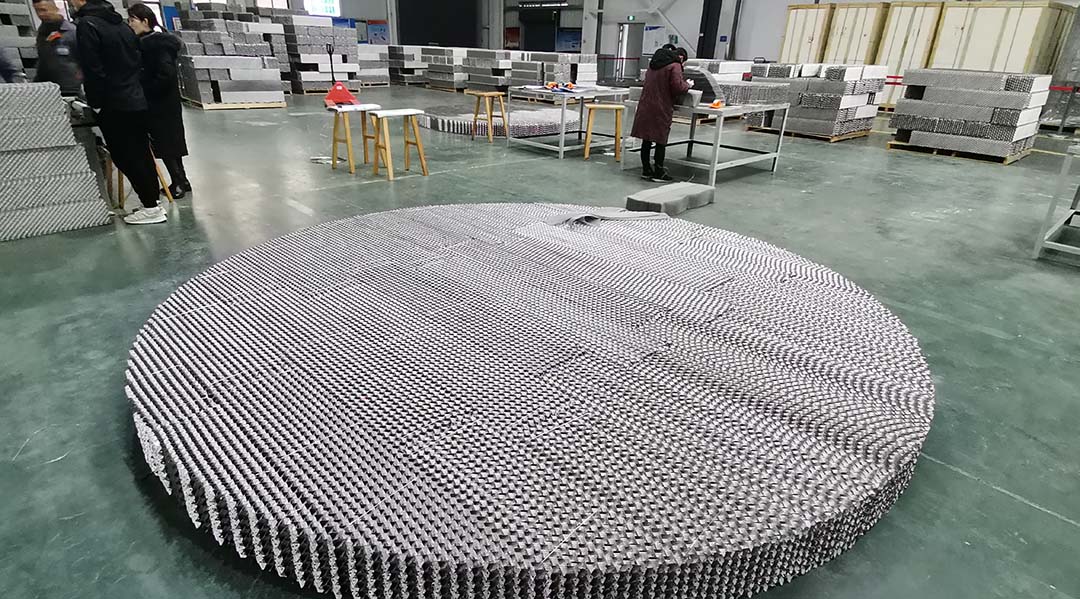
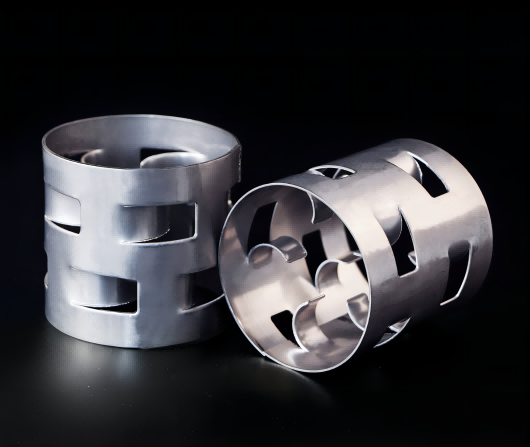
Metal structured packing consists of corrugated metal sheets or wire gauze arranged in a geometric, repeating pattern to form a highly organized packed bed. Unlike random packings (e.g., Metal Super Raschig Rings or Metal Intalox Saddles), the geometry is predetermined and uniform throughout the tower cross-section, eliminating the randomness that causes channeling and maldistribution.
The corrugated sheets are typically perforated and embossed with texturing to promote liquid spreading. Sheet metal packings (250Y, 350Y, 500Y) are the workhorses for petrochemical services, while wire gauze packings (BX, CY) are reserved for high-purity distillation where maximum efficiency is required.
Key construction materials:
- • SS304 / SS304L: General-purpose austenitic stainless steel for most petrochemical services; excellent resistance to organic acids and moderate chlorides.
- • SS316 / SS316L: Enhanced molybdenum content for superior resistance to chlorides, sulfides, and acidic crude fractions.
- • SS410: Martensitic stainless steel offering higher mechanical strength at elevated temperatures; suitable for catalytic distillation and high-pressure fractionators.
- • Carbon Steel: Cost-effective for non-corrosive hydrocarbon services such as atmospheric crude distillation and naphtha stabilization.
2. Why Metal Structured Packing Excels in Petrochemical Applications
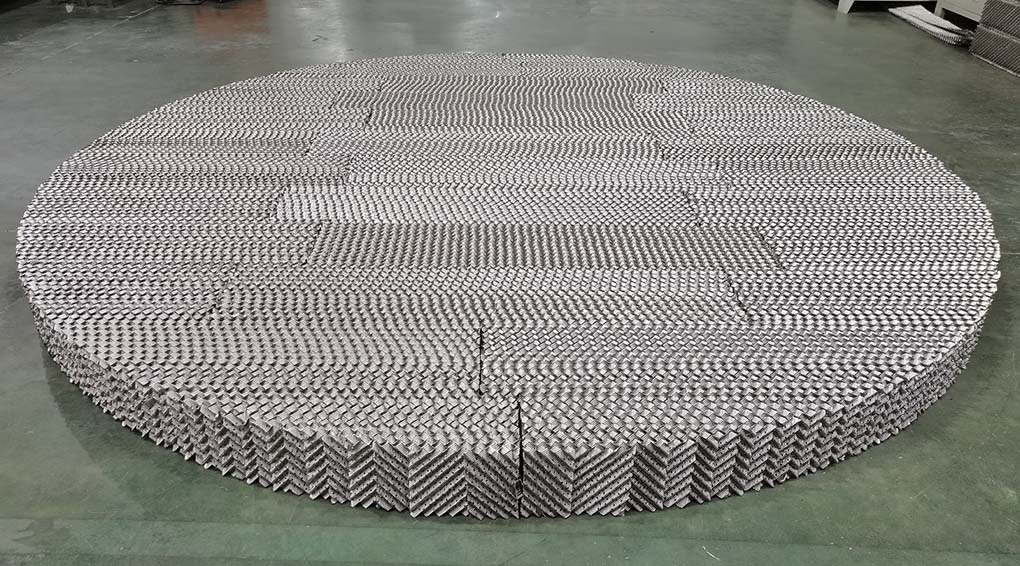
Petrochemical separation towers operate under some of the most demanding conditions in the process industries — high temperatures, corrosive fluids, deep vacuum, and tight product specifications. Metal structured packing addresses these challenges through four core strengths:
01
Ultra-Low Pressure Drop
Why it matters: In vacuum towers (e.g., vacuum gas oil units operating at 20–50 mmHg absolute), every millibar of pressure drop directly reduces product yield and increases cutter temperature. Structured packing delivers pressure drop as low as 0.1–0.3 mbar per theoretical stage.
Design Advantage: The organized, parallel flow channels minimize flow resistance while maintaining high interfacial area. Compared to trays or random packings, structured packing can reduce total column pressure drop by 50–80% in deep vacuum service.
02
High Throughput Capacity
Why it matters: Petrochemical plants demand maximum throughput from existing assets. Structured packing's open structure allows higher F-factor operation (2.0–3.5 Pa0.5) before flooding, compared to 1.5–2.0 for random packings.
Design Advantage: The corrugation angle (typically 45° for Y-type, 60° for X-type) balances gas-liquid contact time with flow capacity. Y-type (250Y, 350Y) is the standard for petrochemical fractionators; X-type is used where maximum capacity is needed.
03
Predictable, Uniform Efficiency
Why it matters: Product specifications in petrochemicals are tight — gasoline RVP, diesel cetane, ethylene purity. Structured packing delivers consistent HETP (Height Equivalent to a Theoretical Plate) across the entire bed, typically 0.2–0.5m for sheet metal types.
Design Advantage: Unlike random packings whose efficiency depends on bed depth and initial distribution, structured packing's geometric regularity ensures every cubic meter performs identically. This enables accurate column sizing and reliable scale-up from pilot to commercial.
04
Durability & Long Service Life
Why it matters: Petrochemical towers undergo thermal cycling, fouling, and occasional upsets. Metal structured packing resists deformation, creep, and corrosion — typical service life exceeds 10–15 years with proper liquid distribution.
Design Advantage: The continuous corrugated sheet structure provides excellent mechanical integrity. Perforations and embossed texture prevent liquid channeling while maintaining structural rigidity. Material selection (316L for sour service, 410 for high-temp catalytic) ensures corrosion resistance matches the duty.
3. Common Types & Specifications
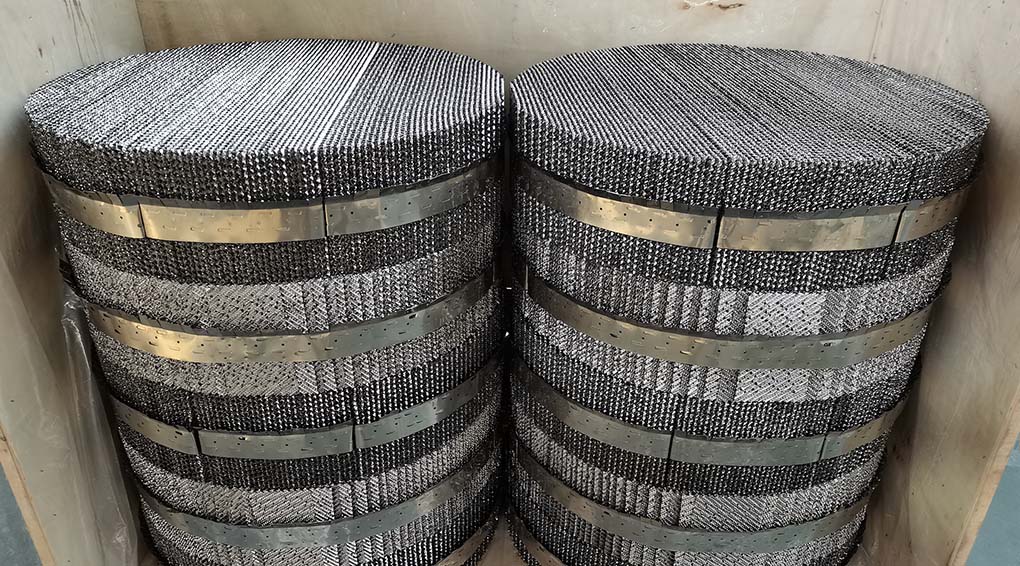
FXSINO supplies a full range of metal structured packings for petrochemical services:
| Type |
Specific Surface (m2/m3) |
Voidage (%) |
Typical HETP (m) |
Best For |
| 125Y |
125 |
98 |
0.35–0.50 |
Atmospheric crude, large-diameter columns |
| 250Y |
250 |
97 |
0.25–0.40 |
General fractionation, vacuum towers |
| 350Y |
350 |
95 |
0.20–0.30 |
High-purity distillation, ethylene |
| 500Y |
500 |
93 |
0.15–0.25 |
Fine separation, small-diameter columns |
| BX (Wire Gauze) |
500 |
90 |
0.10–0.20 |
High-purity, low-load distillation |
4. Typical Petrochemical Applications
- • Crude Distillation Units (CDU): Atmospheric and vacuum towers benefit from structured packing's low pressure drop and high capacity. 250Y and 350Y are standard for side-strippers and main fractionators.
- • Vacuum Gas Oil (VGO) Units: Deep vacuum operation (10–50 mmHg) demands ultra-low ΔP. Structured packing is the only viable choice to maximize cutter yield and minimize thermal cracking.
- • Amine Regenerators: CO2 and H2S removal from sour gas streams. SS316L structured packing resists amine degradation products and hot potassium carbonate corrosion.
- • Catalytic Distillation: Reactive distillation columns (e.g., MTBE, TAME synthesis) use structured packing as catalyst support. SS410 offers the mechanical strength and thermal stability required.
- • Olefin Separation: Ethylene-ethane and propylene-propane splitters require high-efficiency 350Y or 500Y to achieve polymer-grade purity within practical column heights.
5. Installation & Support Considerations
- Bed Installation: Structured packing is installed in stacked layers (typically 100–300mm per bed). Each layer must be leveled precisely — a deviation > 3mm per meter causes liquid maldistribution and efficiency loss.
- Liquid Distribution: Critical. Structured packing is unforgiving of poor distribution — use a high-quality liquid distributor with ≥ 100 drip points per m2 for 250Y/350Y; ≥ 200 points/m2 for 500Y.
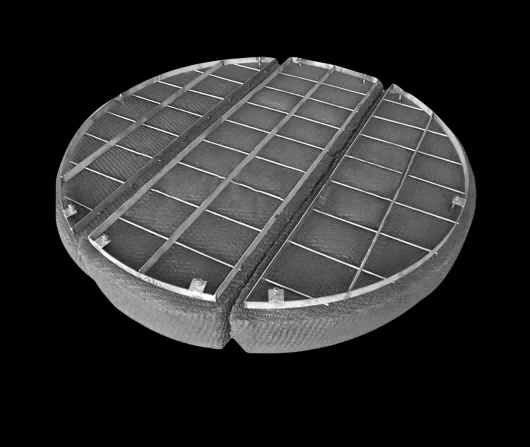
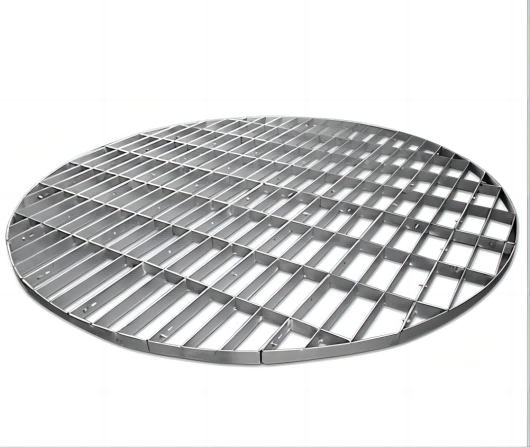
- Bed Limiters: Install hold-down grids above each structured packing bed to prevent lifting under high gas velocity or pressure surges.
- Inspection & Cleaning: Periodic CUI (corrosion under insulation) checks and mechanical cleaning if fouling occurs. Structured packing can often be cleaned in-place with solvent wash or steam-out.
6. Quick FAQ
Q: Structured packing vs. random packing — which for petrochemical?
A: For new builds and revamps where pressure drop, capacity, or efficiency are critical (vacuum towers, high-purity splitters), structured packing is the clear winner. Random packings like Metal Super Raschig Rings are still valid for less demanding services, smaller diameters, or where budget is the primary constraint.
Q: What material for sour service (high H2S + CO2)?
A: SS316L is the standard for amine regenerators and sour water strippers. For extremely aggressive conditions with chlorides > 50 ppm, consider duplex stainless (2205) or higher-alloy materials.
Q: Can structured packing be retrofitted into an existing tray column?
A: Yes. Replacing trays with structured packing is a common revamp strategy to increase capacity by 20–50% and reduce pressure drop. FXSINO provides complete EPC support including tower internals, distributors, and packing installation supervision.
FXSINO is a manufacturer of tower packing & internals — metal structured packing, Metal Intalox Saddles, Metal Super Raschig Rings, and complete column internals. Custom materials, shipped worldwide.
Tell us your tower diameter, service fluid, operating pressure/temperature, and separation requirements. We'll recommend the right packing type, calculate bed height, and provide a same-day quote with lead time.
Contact FXSINO: jackieqiu9202@gmail.com | +86 18507999558

 Address : Intersection of Jinguang Avenue and Chongqing Middle Road, Anyuan Industrial Park, Anyuan District, Pingxiang City, Jiangxi
 Tel : +86-18507999558
 Email : sales@fxsino.com
 WhatsApp :
+86-18507999558
WhatsApp :
+86-18507999558 IPv6 network supported Sitemap | XML | Blog | Privacy Policy