Projects

Detailed explanation of the structure and design characteristics of ceramic saddle ring packing.

Home Projects

Detailed explanation of the structure and design characteristics of ceramic saddle ring packing.

Detailed explanation of the structure and design characteristics of ceramic saddle ring packing.
October 25, 2025


Engineer's Brief: The ceramic saddle ring (also called ceramic Intalox saddle ring) is a classic random packing whose shape sits between a ring and a saddle. Its asymmetric double-arc body prevents nesting, promotes point contact between pieces, and keeps bed voidage high (70–85%). Molded from chemical porcelain or high-alumina ceramic, it resists all inorganic/organic acids except HF and runs continuously at 1000–1200°C — making it irreplaceable in sulfuric acid dryers, hot acid gas scrubbers, and high-temperature corrosive towers where plastic and metal packings fail.[8,21](@ref)
1. What Is Ceramic Saddle Ring Packing?

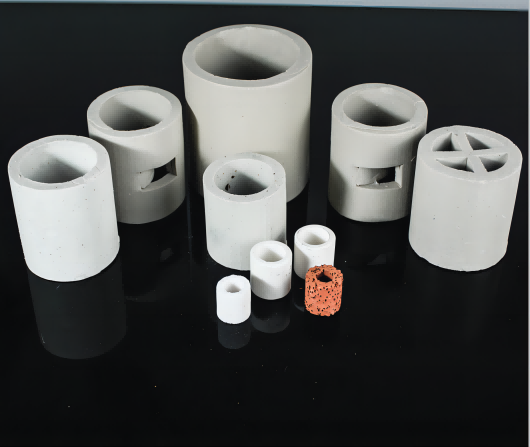
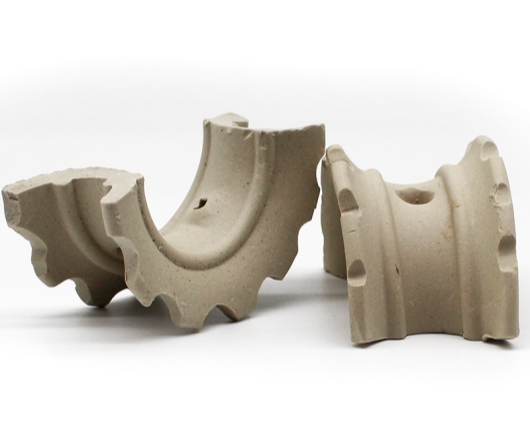
Bulk ceramic saddle ring packing showing saddle-shaped curved bodies in chemical porcelain

Figure 1: Ceramic saddle ring (Intalox saddle) — bulk chemical-porcelain pieces showing the characteristic saddle-shaped curved body.

The ceramic saddle ring evolved from the earlier Berl saddle (arc saddle). Its key modification is that the symmetrical arc saddle ends are changed into a rectangular-type contact surface, while the body keeps a saddle-like double curvature — one concave outer face, one convex inner face, open at both ends with no closed cavity.[8,15](@ref) This semi-ring, semi-saddle geometry is why it is also marketed as "rectangular saddle ring" or "Intalox saddle ring".

Unlike metal Intalox saddles or plastic hollow ball packings, the ceramic version trades some specific surface area for extreme chemical inertia and thermal endurance. It is a random dumping packing — poured loosely into the tower without stacking order.

2. Geometric Structure Breakdown

The shape is engineered, not arbitrary. Each element is a continuous extruded/compressed ceramic body with the following structural traits:
01

Asymmetric Double-Arc Body

Geometry: Two arcs of different curvature meet at a central ridge. One face is concave (outer saddle), the other convex (inner saddle). Ends are truncated into roughly rectangular planes rather than symmetric arcs.[2,8](@ref)
Design Effect: The asymmetry stops pieces from rotating into identical orientation; random dump produces mixed angles, so neighboring saddles touch at points instead of nesting face-into-face. This breaks up dead zones and keeps void distribution uniform.
02

Rectangular End Contact Surface

Geometry: Both open ends terminate in near-rectangular flats instead of continuing arcs (the improvement over original Berl saddle).[8,15](@ref)
Design Effect: Rectangular ends reduce bridging/overlapping that pure arc saddles suffer. They also give a small stable seating plane so a saddle rests on neighbors without rolling into a nested pair — raising effective voidage vs. Raschig rings of the same nominal size.
03

Open Dual-End Channel, No Closed Cavity

Geometry: Hollow through-body, open at both truncated ends, no interior blind pocket.[8,25](@ref)
Design Effect: Gas and liquid pass through the same opening rather than only skimming an outer wall. Liquid films form on both concave and convex faces; gas takes curved low-resistance paths. No trapped pocket means less foulant accumulation in slurry scrubbing.
04

Surface Texture & Wall-Thickness Variation

Geometry: Fired ceramic surface carries micro-roughness and slight embossing; wall is slightly thicker near the central ridge (load path) and thinner toward edges.[2](@ref)
Design Effect: Micro-roughness improves wettability (liquid spreads into thin film, not beads). Local thickening at the ridge raises crush strength (≥ 4.4 N/mm² compressive; bulk pieces ≥ 3000 N for DN50) without adding total weight.[9,20](@ref)
Close-up of single ceramic saddle ring showing rectangular ends, double arc, open channel

Figure 2: Single ceramic saddle ring — rectangular ends, double-arc body, open through-channel.

3. Material & Dimensional Design

Ceramic saddle rings are formed by extrusion or dry pressing of chemical-porcelain / high-alumina body, then fired at 1200°C+ to produce a dense sintered matrix (SiO₂ 65–75%, Al₂O₃ 17–23%, Fe₂O₃ <1.5%).[5,9](@ref) Design consequences:

  • • Chemical inertness: Resists all inorganic acids, organic acids, solvents; only HF and hot concentrated alkali attack it. Acid resistance ≥ 99.6%.[6,21](@ref)
  • • Thermal limit: Continuous 1000–1200°C; short peak ~1400°C; low thermal expansion, good thermal-shock cycling.[9,21](@ref)
  • • Low absorption: Water absorption ≤ 0.5%, density 2.3–2.9 g/cm³ — no swelling, no leachate contaminating product.[5,20](@ref)
  • • Dimensional control: Outer-diameter tolerance ±0.5mm (small), ±1mm (DN76+); height ±0.8–1.5mm; wall ±1mm.[10](@ref)

Standard nominal sizes 16 / 19 / 25 / 38 / 50 / 76 mm. Typical geometry table:

Size (mm) D × H × T (mm) Surface Area (m2/m3) Voidage (%) Bulk Density (kg/m3)
25 25 × 19 × 3 250 74 610
38 38 × 30 × 4 164 75 590
50 50 × 40 × 5 142 76 560
76 76 × 57 × 9 92 78 520

Data per common ceramic Intalox saddle specs.[5,18](@ref)

4. Design Characteristics That Matter in Operation

  • • Anti-nesting & uniform void: Asymmetric saddle + rectangular ends → point contact, no face nesting, voidage 70–85% held uniform across bed.[2,8](@ref)
  • • Low ΔP, high flood point: Curved open channels give tortuous-but-low-resistance gas path; pressure drop ~25% lower than same-size Raschig rings; higher allowable vapor velocity before flooding.[4,8](@ref)
  • • Liquid film control: Micro-rough ceramic + concave/convex faces spread thin liquid film on both sides; arc ridges cut wall flow and channeling.[2,15](@ref)
  • • Mechanical survival: Crush strength ≥ 4.4 N/mm², bulk piece ≥ 3000 N (DN50); survives deep-bed self-weight and thermal cycling without spalling.[9,20](@ref)
  • • Upgrade path — Super saddle: Ceramic Super Intalox saddle replaces smooth arcs with serrated/corrugated edges and adds inner-outer openings, pushing voidage to ~78–84% and cutting ΔP further.[12,22](@ref)

5. Where the Structure Pays Off

The structure is purpose-built for hot, acidic, oxidizing gas-liquid contact where metal corrodes and plastic melts:[8,21](@ref)

  • • Sulfuric acid plant: Drying tower (98% H₂SO₄) and absorption tower — ceramic saddle is the default packing.
  • • Hot flue-gas scrubbing: SO₂/NOₓ removal with limestone slurry, HCl exhaust, chlorine drying.
  • • High-temp distillation/stripping: Where service > 150°C rules out plastic; e.g., certain caustic evaporation tails.
  • • Metallurgy & coke-oven gas: Ammonia liquor scrubbing, naphthalene wash, gas cooling towers.

6. Quick FAQ

Q: Saddle ring vs. Raschig ring in ceramic — structurally?

A: Raschig ring is a plain hollow cylinder — tends to stack in columns, creates dead zones, higher ΔP. Saddle ring's asymmetric double-arc + rectangular ends force point contact and uniform voids, giving lower pressure drop and better distribution at equal size.[8,21](@ref)

Q: Why not use metal Intalox saddle instead?

A: Metal versions (304/316) win on strength-to-weight and some efficiency cases, but dissolve in sulfuric/nitric/hydrochloric acid service and soften far below ceramic's 1000°C+ ceiling. In acid plants ceramic is mandatory.[21](@ref)

Q: Any structural weak point?

A: Ceramic is brittle — do not drop from height > 2m during charging; use chute. Avoid HF and hot concentrated NaOH. Otherwise the sintered body outlasts most tower shells.

Get a Quote for Ceramic Saddle Ring Packing

FXSINO manufactures ceramic Intalox saddle rings, Super Intalox saddles, ceramic Raschig rings, and tower internals. Sizes 16–76mm, chemical porcelain or high-alumina, shipped worldwide.

Send tower diameter, bed depth, service fluid (note if HF present), operating temperature, and preferred size. We'll confirm material grade, packing volume, and lead time the same day.

Contact FXSINO: jackieqiu9202@gmail.com | +86 18507999558

leave a message

leave a message
If you are interested in our products and want to know more details,please leave a message here,we will reply you as soon as we can.
submit

Home

Products

whatsApp

contact